
Adiabatic Trim: The Cost of Taking a “Wait and See” Approach During Design
What Is Adiabatic Trim?
Perhaps you’re familiar with adiabatic systems and their benefits. For those not familiar, an adiabatic system uses water to absorb heat from a system and releases it into the air via evaporation. There are many types of adiabatic systems, from evaporative walls to cooling towers and garden sprinklers to swamp coolers. Adiabatic systems have been effective at rejecting heat for ages. But for the purposes of this article, we will focus primarily on adiabatic pre-cooling systems, and specifically on the precise tuning of those systems, to reduce peak PUE and water usage.
Pilots don’t trim an aircraft to eliminate their workload. They trim to precisely adjust their control surfaces to a stable, neutral position—reducing operator intervention so they can focus on other critical tasks.
Adiabatic trim is a similar idea as the aviation example above but applied to data center cooling: precision control of an adiabatic pre-cooling system to manage entering air temperature at an air-cooled chiller or dry cooler, maximizing cooling efficiency without constant operator intervention. To belabor the metaphor, the “neutral position” we are “trimming” is the condenser entering air temperature. Adiabatic pre-cooling—the process of evaporating water into the ambient airstream before that air reaches the condenser coils—certainly reduces the workload of a chiller compressor, but chillers are designed to work at high ambient temperatures, and pre-cooling that ambient air is not always prudent. Better instead to allow that chiller compressor to operate uncooled to its designed “neutral” and then, when ambient conditions meet or exceed the desired temperature, cool to that temperature. Adiabatic trim is the prudential intervention that allows the chillers to focus on the critical task of cooling.
Most pre-cooling solutions such as flooded media, sprinklers, or misting systems are on-off at best. They use more water than is necessary. In the aviation world, we used to scold students for trimming too much while flying in the clouds where workloads increase and the consequence of not having a stable aircraft becomes catastrophic. We should be similarly critical of technologies than use more water than is needed to achieve design performance of air-cooled chillers and dry coolers.
This article is not about whether to use adiabatic pre-cooling—you should. Instead, this article is about when to decide to use it—during design or as a band-aide after the build. Controlling peak conditions should not be an afterthought—it’s a design decision that ripples upstream into electrical infrastructure sizing, downstream into water consumption permits, and sideways into whether the community next door lets you build at all.
Here’s the claim in a nutshell: deferring that decision has a measurable price tag. The rest of this article shows you the logic.
Real-World Scarcity
Space is scarce: they ain’t making any more of it. But the land required for new development is not the primary concern. No, the concern is convincing the general populace to allow you to purchase and develop the land. Although large parcels of land exist, residents concerned about the noise, the strain on the power grid, the heat output, and the use of water reserves, are the constituents that often need to be assuaged.
AI adoption has been growing rapidly in the last couple of years. Communities can barely keep up with the growth of infrastructure and the adoption of AI technologies, let alone the industry’s growing demands for resources. The consumption of resources for the given amount of acreage is what’s causing municipalities, states, and even the federal government to consider regulating the development of new data centers. As data centers pop up around the country, utility companies often need to expand their capacity and output, and in some cases, residents wind up footing the bill. On-site water consumption—to say nothing of the water consumed for power generation—becomes a huge concern for citizens in drought-prone areas or areas where reservoirs are a major supplier of potable water. With increasing utility bills and the strain on water resources, communities become reluctant to allow new data center developments.
There are a thousand challenges that need to be overcome when contemplating a new data center development. But disregarding the challenges of resource consumption while planning and designing will make a new data center dead on arrival in the eyes of the public. And as we’re seeing right now in Prince William County, “arrival” can come well after millions of dollars in investment. The public’s perception is directly tied to your bottom line. Consider the $64 billion in blocked or delayed data centers. How much money is currently tied up with no ROI? What will future litigation cost? What compute power is completely untapped? Someone signing the checks is calculating those numbers right now.
So what could change the calculus? Two things: water and power. And it turns out that getting adiabatic trim right—during design, not after the concrete is poured—addresses both.
Water
Closed-loop cooling systems with adiabatic trim can reduced water consumption by more than 97% compared to open-loop systems. Read that again. Ninety-seven percent. If your facility is consuming millions of gallons a year through cooling towers, that number should keep you up at night—not because the technology doesn’t exist, but because it does, and you’re not using it.
Adiabatic cooling methods have been withdrawing heat from open-loop systems for as long as systems have needed cooling. Adiabatic pre-cooling—cooling the incoming airstream, upstream of the condenser coils, in a closed-loop system—has been around for a while too. But adiabatic trim—the precision control of when, how much, and under what conditions that water is applied—is quickly becoming an essential component of scarce resource planning. In the age of flooded media, you ran wet or you ran dry. Trim gives you a third option: run precisely.
That precision is what makes the 97% figure possible, and it’s what makes the difference between a project that gets permitted and one that joins the $64 billion pile. A team that can walk into a planning board and say “this system operates dry for 98% of annual hours and activates only during peak conditions” is telling a fundamentally different story than one that shows up with a cooling tower water budget.
But none of that story is available to tell if the trim parameters were never defined—or were defined with a shrug and a “we can always add more chillers.”
Power
A 300 MW data center with a peak PUE of 1.5 can lease 200 MW of critical IT load. Drop that peak PUE to 1.35 with adiabatic trim, and you free up another 22 MW. At $175,000 per MW per month, those 22 MW are worth $3.8 million per month and $46 million per year in lease revenue—from the same building, the same utility subscription, the same footprint.
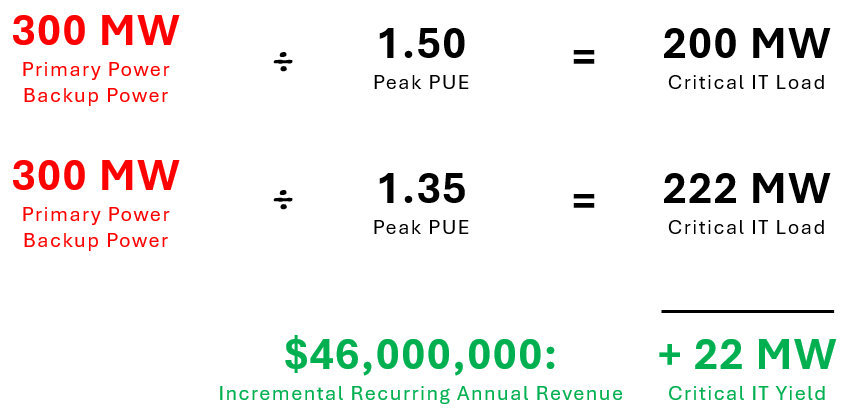
That’s the upside. Now consider the downside that trim prevents.
Picture a data center that’s up and running. A heat wave sweeps the region. Power demand spikes. The chillers go into overdrive to handle the IT load. The generators kick on. And the wind pushes all of that generator exhaust straight into the chiller yard and into the condenser inlets. Those already maxed-out chillers are now fighting an entering air temperature 10–20°F above design conditions. Their compressors are straining to maintain a temperature differential on the compressor that the design never accounted for.
This scenario—not hypothetical, not rare—is the main driver of adiabatic pre-cooling business today. The “colo” operator calls a company to target specific chillers for adiabatic pre-cooling due to a failing external CFD; the technology is installed, and the data center survives. Crisis averted.
But here’s the question too few are asking: why was this a crisis at all? The answer is that many owners are taking a ‘wait and see’ approach during design. Nobody asked what the actual entering air temperature would be at the condenser inlet—accounting for recirculation, generator exhaust, and solar loading—and sized the cooling infrastructure accordingly. They designed to a nameplate ambient condition and hoped the real world would cooperate. It didn’t.
Adiabatic trim turns that condition—ambient temperature at the condenser inlet—from a variable to which you react into something you control. And if you control it, you don’t need to overbuild for a design day that assumes 130°F at the chiller yard. You build for reality and trim for the peaks.
The “Wait and See” Trap
Here’s how it happens.
During site selection, the team locks in a location and begins conversations with the utility. During design, the building footprint takes shape: floor area, structural loading, electrical room square footage, and the general cooling strategy. They select chillers and procure chillers, which are a long lead time item. They move forward with an electrical design based on a presumed peak PUE—one derived from chiller input power at a design condition (for example, ASHRAE N=20). They do not consider how chiller yard recirculation and generator exhaust air can add 10–20°F to the entering air temperature at the condenser inlets, and that this additional temperature translates directly into higher input power to the chillers. They are electrically oversubscribed before they even break ground.
On the surface, assuming a peak PUE based on a design day sounds reasonable. But “wait and see” is not a neutral position. It’s a decision to design for textbook assumptions while hoping real-world conditions mirror those assumptions—and they don’t. The costs compound at every stage.
When peak PUE is not fully understood and the cooling solution is generic, things go in one of two directions—both bad. Either the engineers overbuild to handle worst-case, and the constraints of UPS and downstream systems strand power that can never be expanded into. Or they design to worst-case and an even-worse-than-worst-case scenario manifests. By the time the building is operational, you’ve paid for infrastructure capacity you may never use, cannot use, or will exceed.
The Real Cost
Let’s go back to our data center that just survived the generational heat wave. The fact that all the infrastructure was already designed for worst-case scenario played out well. Or did it?
A “wait and see” attitude can be salvaged, but the penalties for delaying a critical pre-cooling decision are real, compounding, and largely invisible until someone does the math.
Oversized and stranded equipment. When chillers or dry coolers are selected based on max load and worst-case ambient—as though entering air temperature were a mere variable to mitigate later—the result is often more or larger units than needed, or units configured for a duty that doesn’t match the actual operating profile. And it’s not just the cooling equipment. When the trim condition isn’t defined, generators, switchgear, pumps, and electrical substations all carry excess capacity to cover the uncertainty. That excess represents millions in stranded capital—and in many cases, creates constraints that prevent future expansion even when demand materializes. Equipment that’s oversized for the load runs at part-load inefficiency for its entire service life or sits idle except for maybe a few dozen hours a year. That’s CAPEX generating zero return.
Retrofit and re-commissioning costs. Engineering research shows that design changes made after construction begins cost 5 to 100 times morethan the same change made during concept or schematic design. Sizing cooling equipment during design development costs an engineer an afternoon. Resizing a cooling plant for a failing external CFD after construction—new piping, revised electrical feeds, a re-commissioning cycle that takes the facility offline—becomes a seven-figure change order. And for every month of that delay, the $175,000-per-MW-per-month lease revenue you built this facility to capture is sitting on the table uncollected.
Add it up. The stranded equipment. The oversized infrastructure. The change orders. The schedule delays. The lease revenue left on the table. None of it was inevitable. All of it traces back to one decision: “Let’s figure out the cooling later.”
The Irony of “Wait and See”
The irony of “wait and see” is that it doesn’t reduce risk. It transfers it. It moves risk out of design—where a change costs a revised spreadsheet—into construction and operations, where a change order costs millions of dollars, or worse yet, chillers derate or fail causing a service interruption.
Projects around the US are being blocked and delayed. Communities are balking on water and power consumption. Utility companies are straining under new demand. AI-driven density is pushing cooling systems to their physical limits. In this environment, every tenth of a peak PUE point is worth real money.
Adiabatic trim is the method that tames this madness. Instead of throwing money at a cooling problem that has materialized, invest it into a precision pre-cooling solution. It can reduce water consumption. It turns ambient temperature at the condenser inlet from a variable into a controllable. By choosing an ambient condition that is most conducive to the performance curve of the air-cooled chiller, you reduce peak PUE. And if you add this reduced peak PUE at the design phase, you can transfer the power that would have gone to cooling to compute power for revenue generation. And it is the difference between a project that gets built and one that joins the $64 billion backlog.
Data centers do not have to be at the mercy of an outraged public. They don’t have to be at the mercy of a once-in-a-hundred-year heat wave. At least one variable can be near-eliminated—but only if the decision is made during design, not after the concrete is poured.
Stop waiting. Start trimming.